China has some 25 million Muslims, spread across the whole country. On city streets you'll sometimes see a green restaurant sign carrying two Chinese characters: 清真 (qīngzhēn). This is China's halal.
Pinwo Editorial5 Oct 20267 min read8 Berlin venues · merchant statements
清真qīngzhēn
The most common halal sign on Chinese streets: green with a gold frame, just the characters 清真 and its pinyin — no Arabic and no star-and-crescent. Illustration, not a specific restaurant.
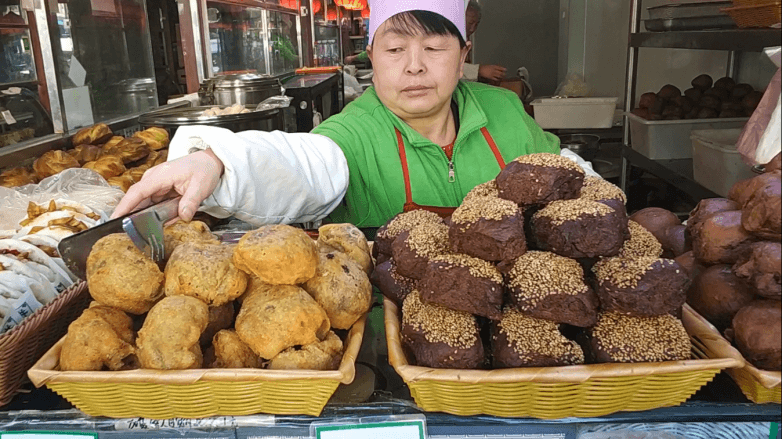
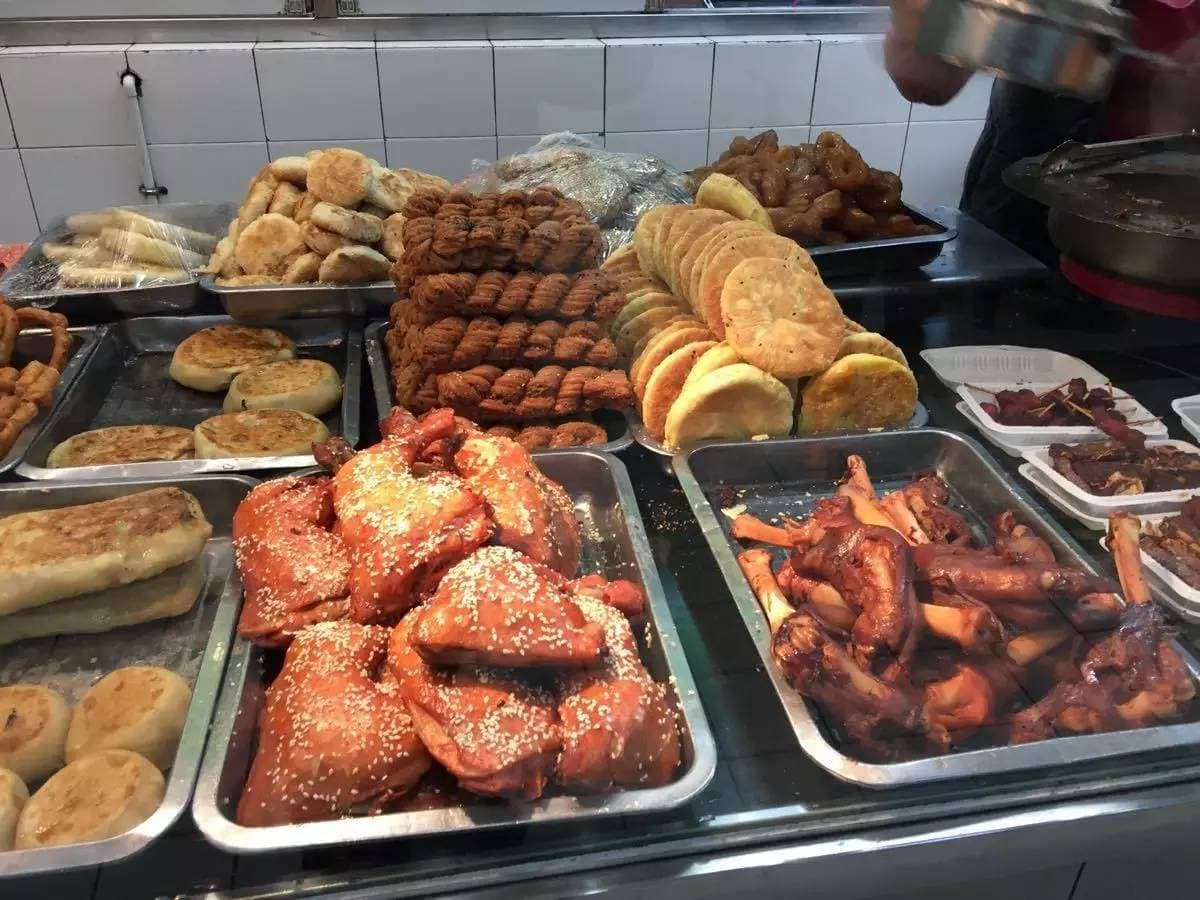
A street food stall in China. Photographed in China.
Berlin has thousands of halal restaurants, and almost none of them are Chinese — yet China has a whole halal cuisine of its own, one many people have never heard of.
01The green door
How to spot halal at a glance in China
In Chinese cities, halal restaurants mostly hang a green sign with the two characters 清真, usually with the pinyin qīngzhēn beneath. See it, and you've found your halal.
清真The two characters are plain-spoken: 清 means clean, 真 means true.
This is unlike Berlin, where halal shops come in red, yellow, any colour, and you go by the word “Halal”, the Arabic script, or knowing the owner. China goes by this green plus two characters.
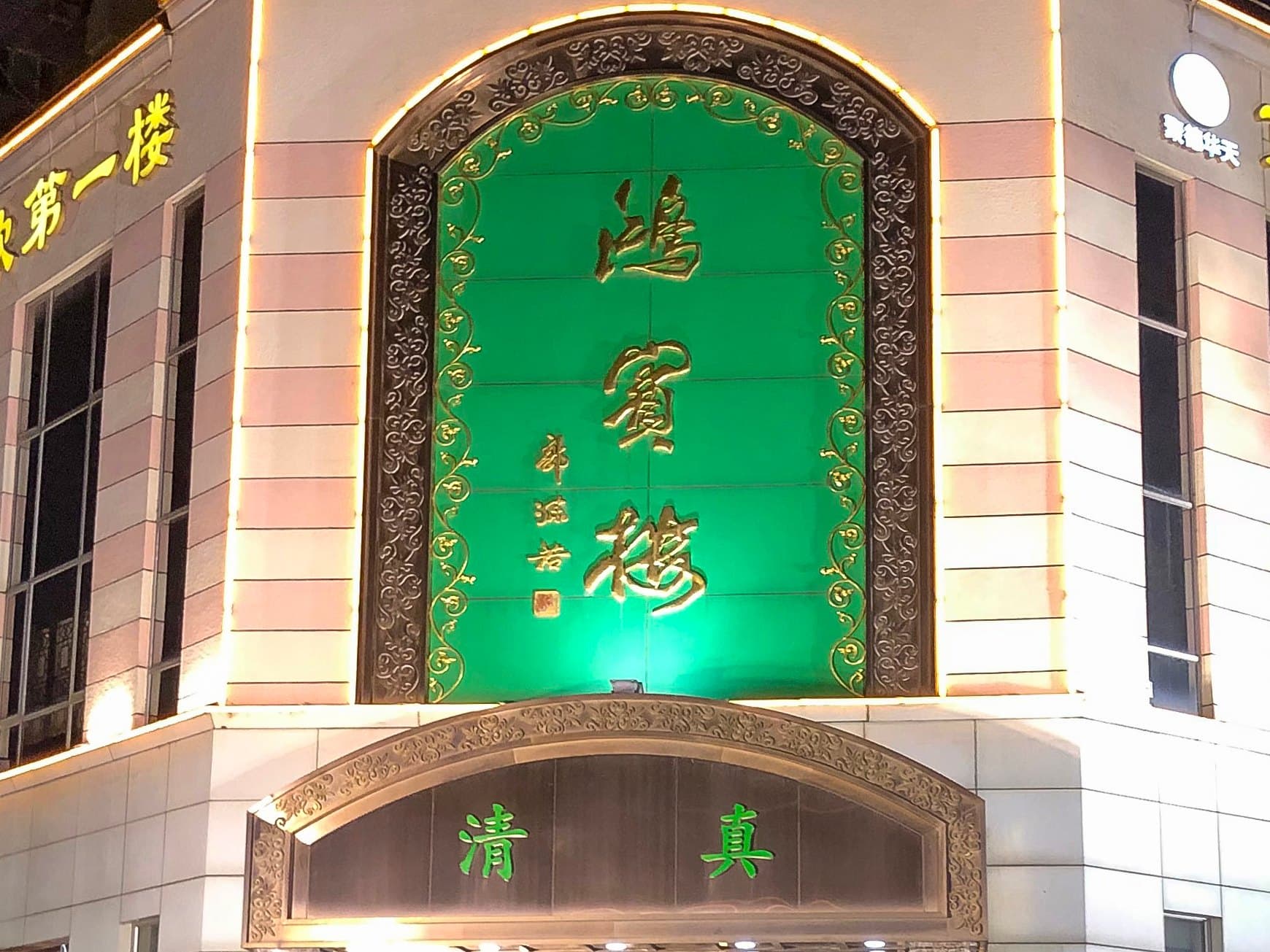
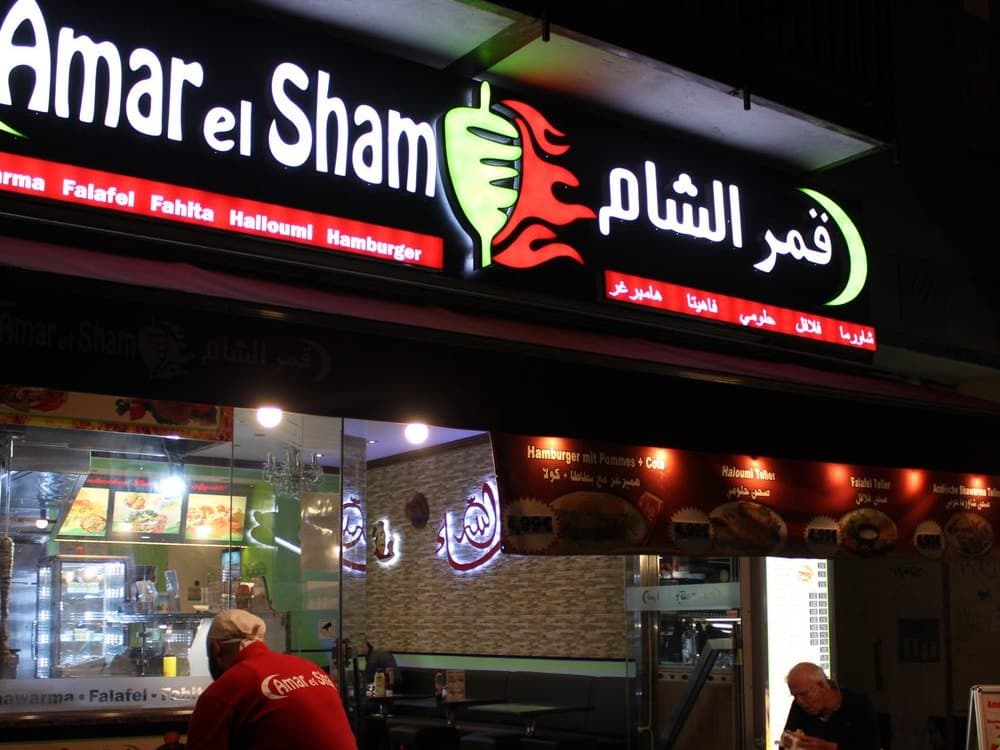
Left: Hongbinlou in Beijing, green and gold with 清真. Right: Amar el Sham in Berlin, black with Arabic and dish names. Same halal, different sign language. (Hongbinlou photo: N509FZ / CC BY-SA 4.0)
Two notes on the green
Not uniform nationwide — some regions (the Northeast, say) use blue signs; one account traces it to Hui forebears there who came from Bukhara and Samarkand and kept Central Asia's blue.
Read the characters, not symbols — these days the signs usually carry no Arabic and no star-and-crescent, and even the colour isn't a rule; what's reliable is the two characters 清真.
02Different from home
In China, look beyond a certificate
This is the one thing to know beforehand. The official halal certification you're used to in Berlin or Istanbul — mainland China has no single nationwide system for it, unlike Malaysia's JAKIM, where one body issues a certificate valid across the country.
What you're used to
One national or institutional certification
A certificate number on the wall or packaging
The same mark wherever you go
How to read it in China
The shop is Muslim-run
A green 清真 sign at the door, often in a Muslim neighbourhood
A community that knows its own — even tea can be “qingzhen”
This isn't looser than a certificate, just a different logic: you read the sign, the owner and the neighbourhood. When unsure, just ask — that's completely normal in China.
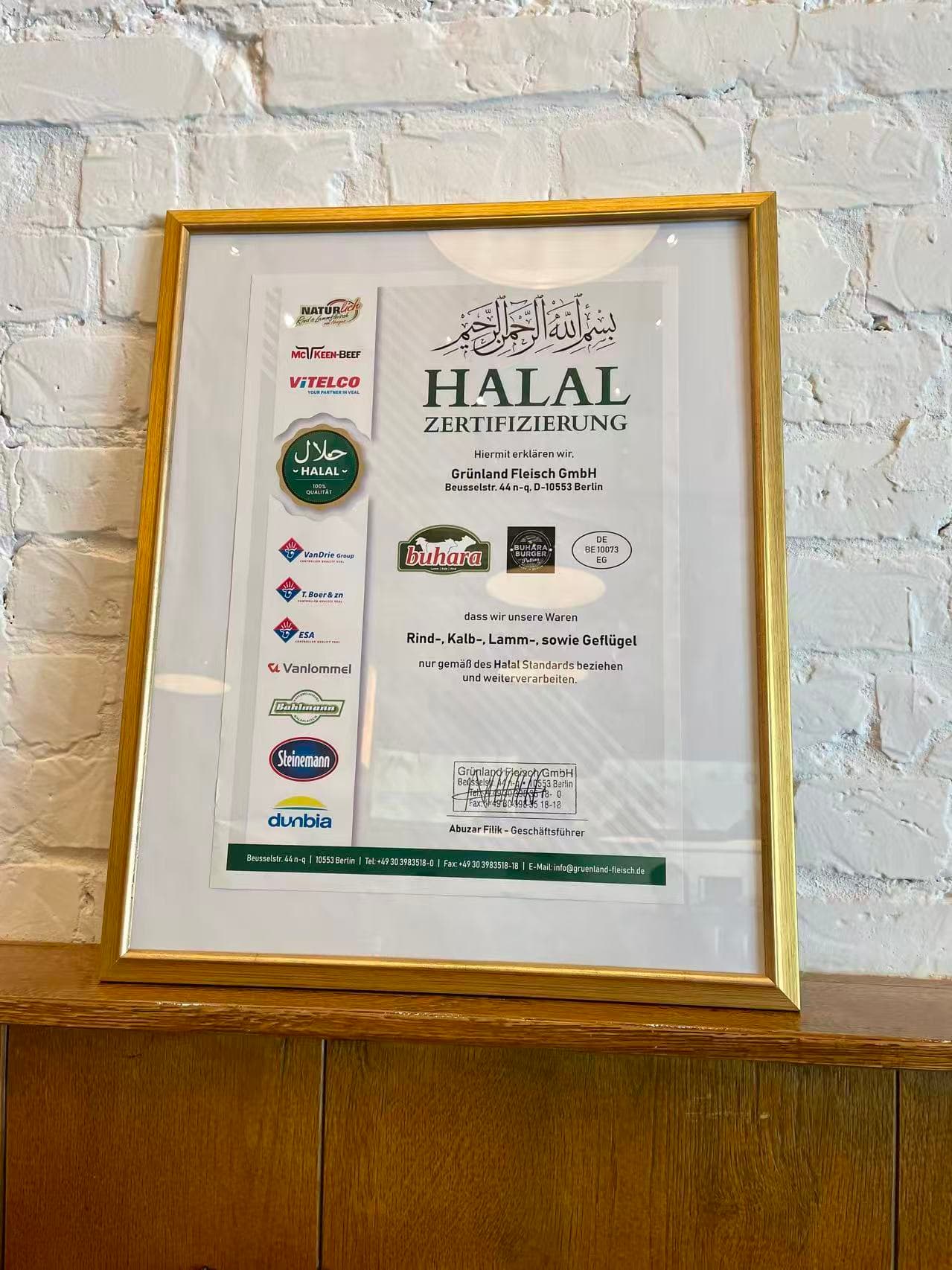
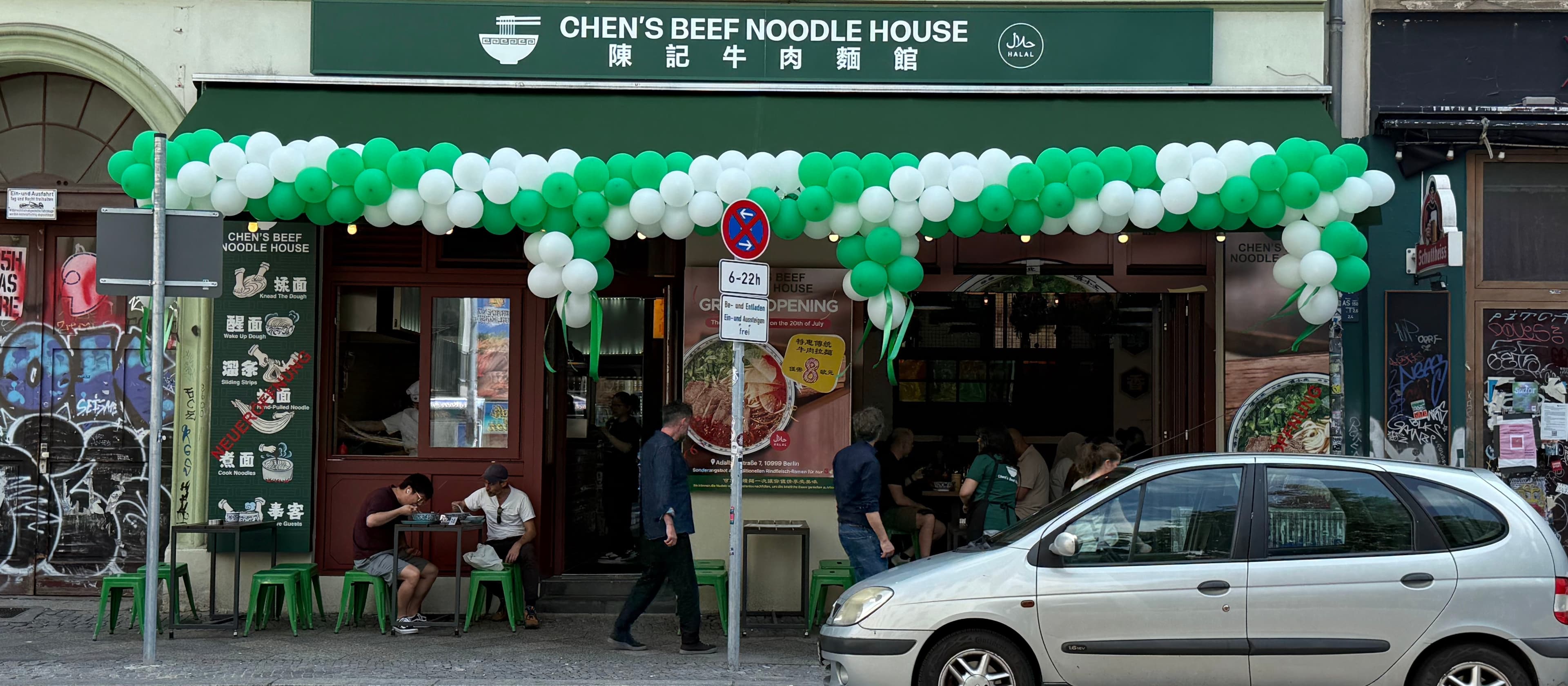
In Berlin it's the other way round: here a Chinese place can give you exactly the paper certificate you know. Chen's displays a halal certificate from its meat supplier Grünland Fleisch — beef, veal, lamb and poultry all sourced to halal standards.
The halal certificate displayed inside Chen's, issued by its meat supplier Grünland Fleisch · photographed in the restaurant.03First door · the familiar one
Uyghur: half this menu, you already know how to order
The food of Xinjiang's Uyghurs is a world of its own. Sit at their table and little will feel foreign — the Silk Road carried these dishes over from Central Asia.
◐ You already know these
Old friends under new names
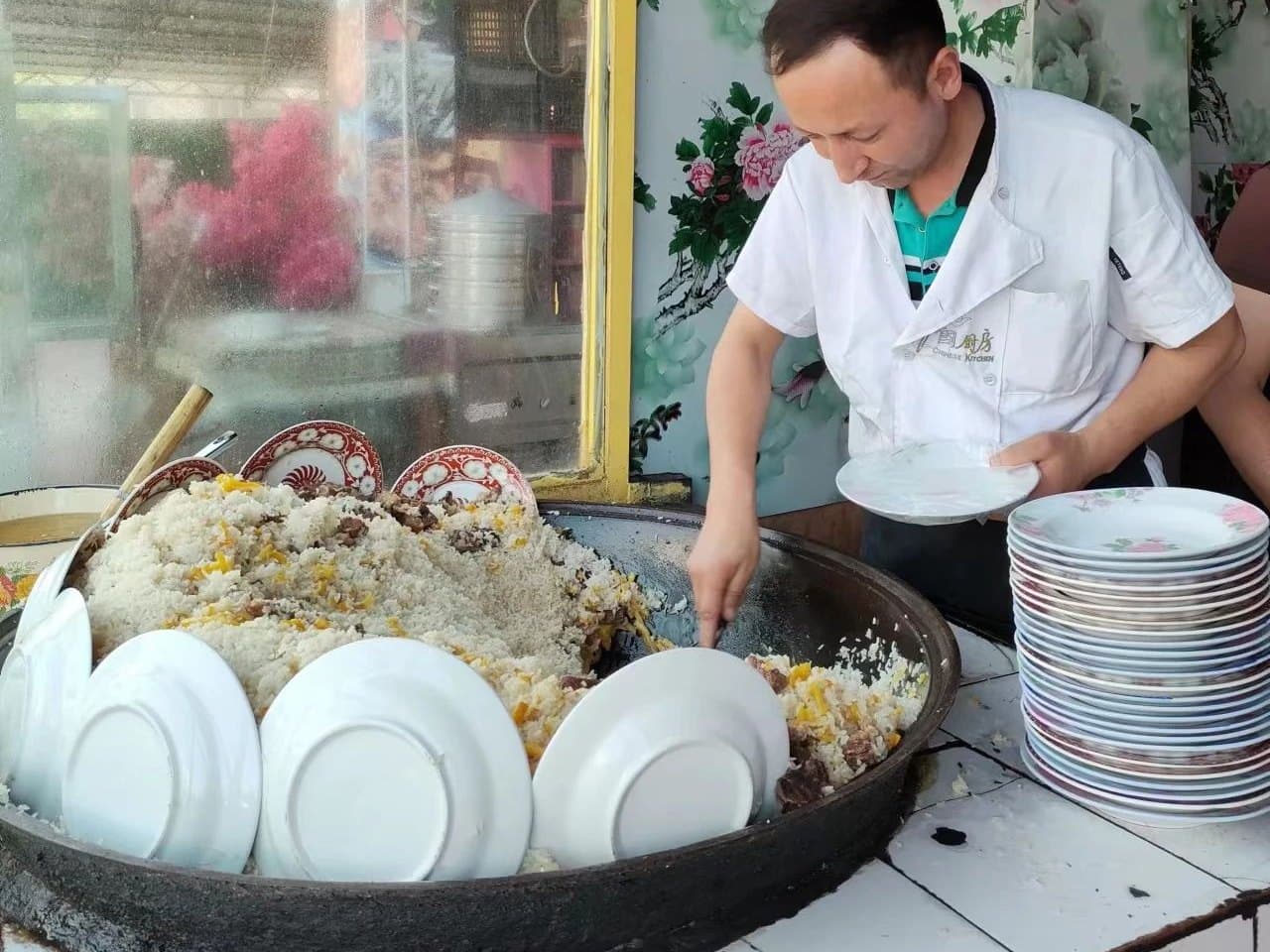
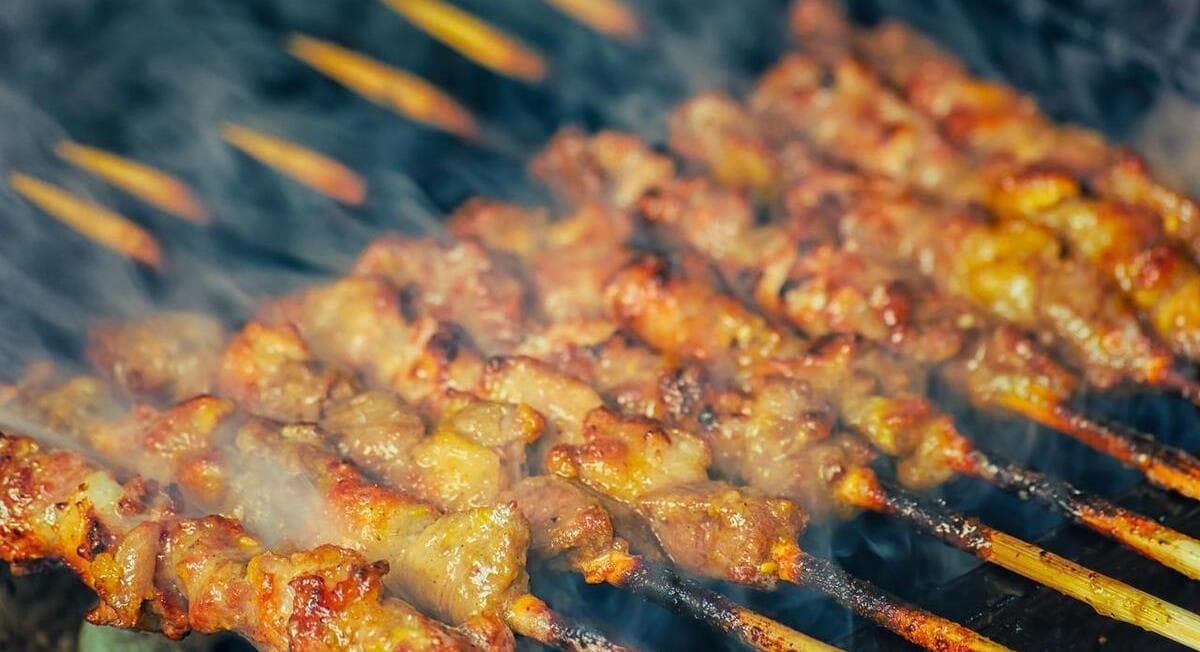
Zhuafan is your pilav; the skewers are kebap; manta is all but mantı. That pot of rice steamed with meat, carrot and onion belongs to one family — from Istanbul to Tashkent to Kashgar.
Left: Xinjiang hand pilaf. Right: charcoal lamb skewers.
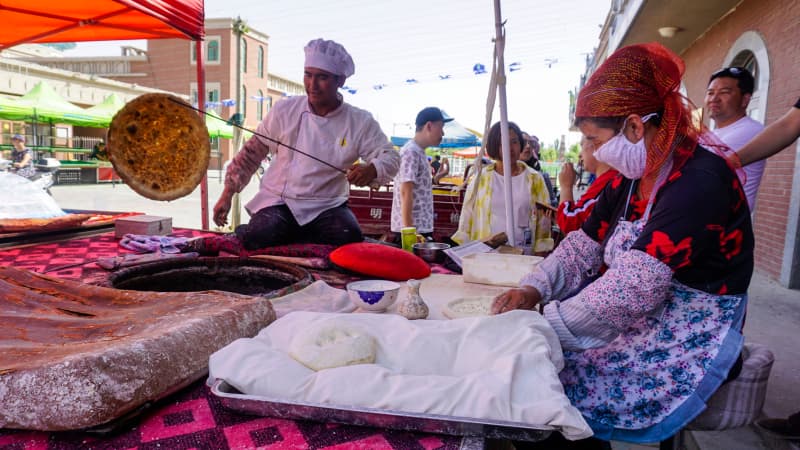
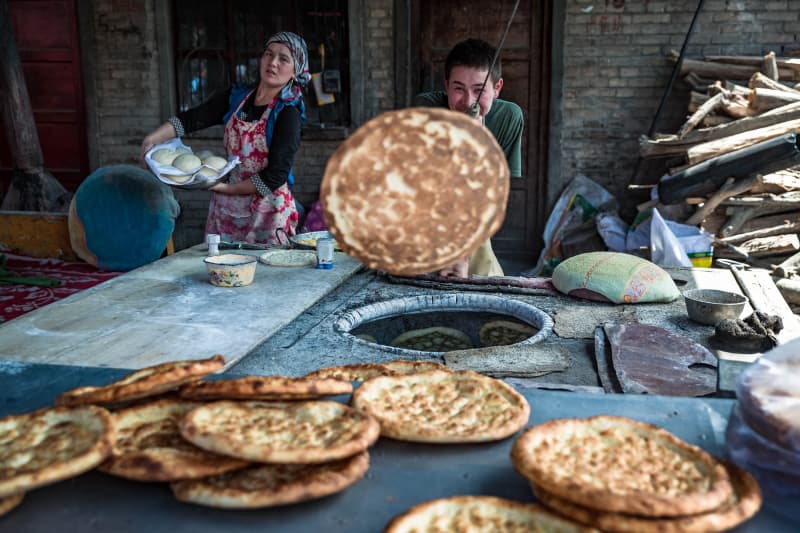
Naan made on the spot: baked against the tandoor wall, wheat-fragrant out of the oven.
If this is your first taste of Chinese halal food, Uyghur is the easiest door in: flavours you know, and rules you can trust.
04Second door · the surprise
Hui: thoroughly Chinese food that's halal throughout
The other half is the more surprising one. The Hui live all across China and cook thoroughly Chinese food — Chinese techniques, Chinese flavours — but halal from start to finish. This isn't “Chinese food with the pork removed”; it's a whole Chinese cuisine that grew up inside halal rules.
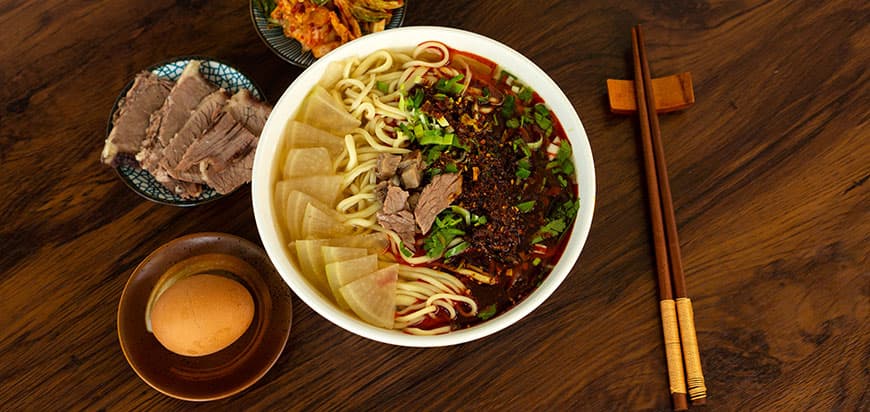
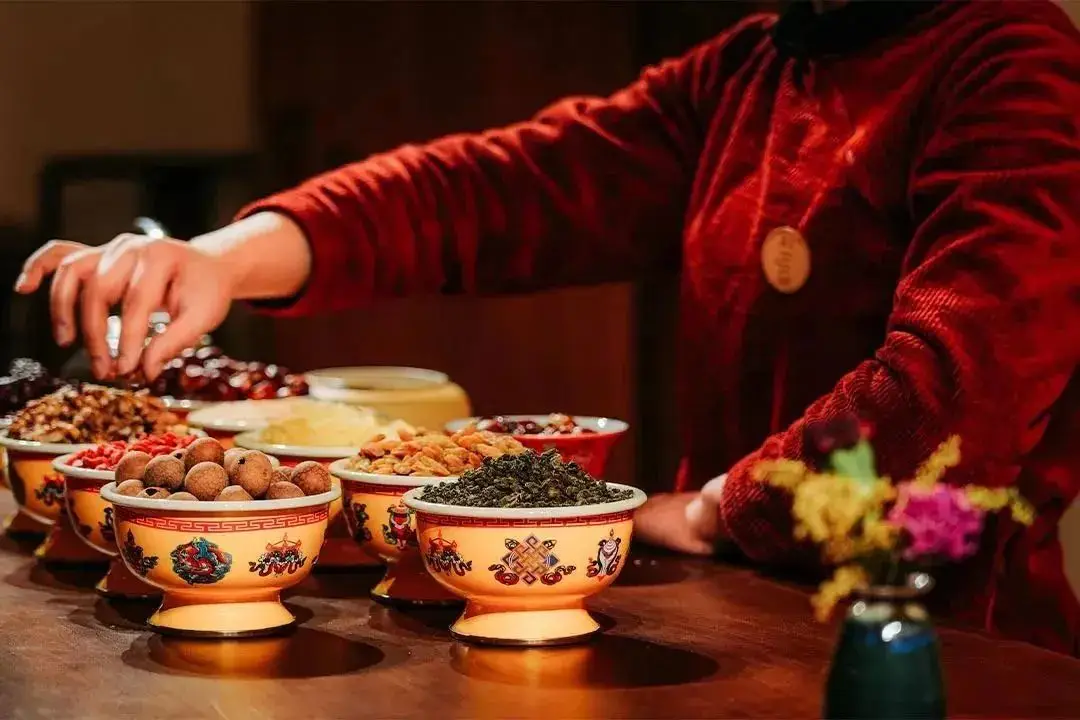
A bowl of Lanzhou beef noodles: clear broth, white radish, red chilli oil, hand-pulled noodles, the beef from halal slaughter. Beijing's Niujie brings mutton hotpot, spiced beef and sesame flatbread — the everyday life of the capital. In Ningxia, guests are welcomed with eight-treasure tea: red dates, longan, goji and rock sugar in the cup, a pot topped up all morning — an old Silk Road custom of hospitality, today a local intangible cultural heritage.
Left: Lanzhou beef noodles — clear broth, white radish, chilli oil, hand-pulled noodles. Right: eight-treasure tea — dates, longan, goji, rock sugar and dried fruit steeped together.
Hui halal can be careful in ways you might not expect: which brand of seasoning, whether the pots have ever touched pork. For anyone who minds, that strictness is reassuring.
05If you travel to China
Learn those two characters and you'll eat better than you'd think
清真 shows up on ordinary streets in nearly every city, and supermarket shelves carry qingzhen-labelled packaged food and snacks. To eat your fill in one place, head to:
Halal street food in China. Photographed in China.
You'll eat a meal that's rich, spicy, thoroughly Chinese — and fully within the rules. For many Muslim travellers, this is China at its most hospitable.
06But you don't have to wait for China
It's already open in Neukölln, Kreuzberg and Wedding
Find beef noodles, malatang / maocai and Chinese skewers in Berlin. Each entry states its halal scope and check date: Mao Master now declares all its food halal, while Han Bites explicitly confirms halal-certified meat only.
The editor's first stop: start with a bowl of clear-broth beef noodles, then add lamb skewers, beef flatbread and chilli-oil wontons — enough to share around a table.
Malatang / maocai · Mao Master1 venue · all food halal, says the business
Mao Master · Kantstraße 50
Charlottenburg · build-your-own malatang / maocai
Choose vegetables, tofu, noodles, meat or seafood, then your broth and spice level. The Kantstraße 50 venue has announced “ALLES IST HALAL” on its official account. This is the business’s statement covering all food, not independent halal certification.
Chinese skewers · Han Bites1 venue · check the scope
Han Bites · Kantstraße 120
Charlottenburg · with KTV
Meat only
Over twenty kinds of Chinese skewers, plus private KTV rooms. The website states it uses halal-certified meat — but that covers the meat only, not the whole venue. A place with KTV may serve alcohol, so if you're strict, ask about other ingredients and kitchen practice first.
Which halal Chinese restaurants in Berlin have direct merchant statements?
Updated on 5 October 2026, this guide lists eight: four Chen's Beef Noodle House branches, two Mr Noodle Chen branches, Mao Master (all food halal according to the business), and Han Bites, which states that it uses halal-certified meat. Menu-item-only, media-only, and branch-unconfirmed venues are omitted for now.
Does pork-free mean halal?
No. Alcohol, meat sourcing and slaughter, animal-derived ingredients, utensils, and cross-contact can also affect halal compliance.
Are Lanzhou noodle shops and Xinjiang restaurants always halal?
No. Those names may connect to Chinese Muslim food traditions, but the current branch still needs its own merchant statement or suitable evidence.
What should I order first?
Clear-broth beef noodles are an easy beginning. Add lamb skewers, beef dumplings, or a cold vegetable dish; on broader menus, look for pilaf, naan, samsa, paomo, or lamb.