
The Berlin Chinese Food Map, Walked Into Being
Rui Fang, the person behind the Xiaohongshu account @Berlin Slowtour, did not begin with an app idea. He began by walking Berlin: through neighbourhoods, galleries, cemeteries and restaurants. The printed map, and later the Berlin Chinese Food app, grew out of that habit of reading the city on foot.
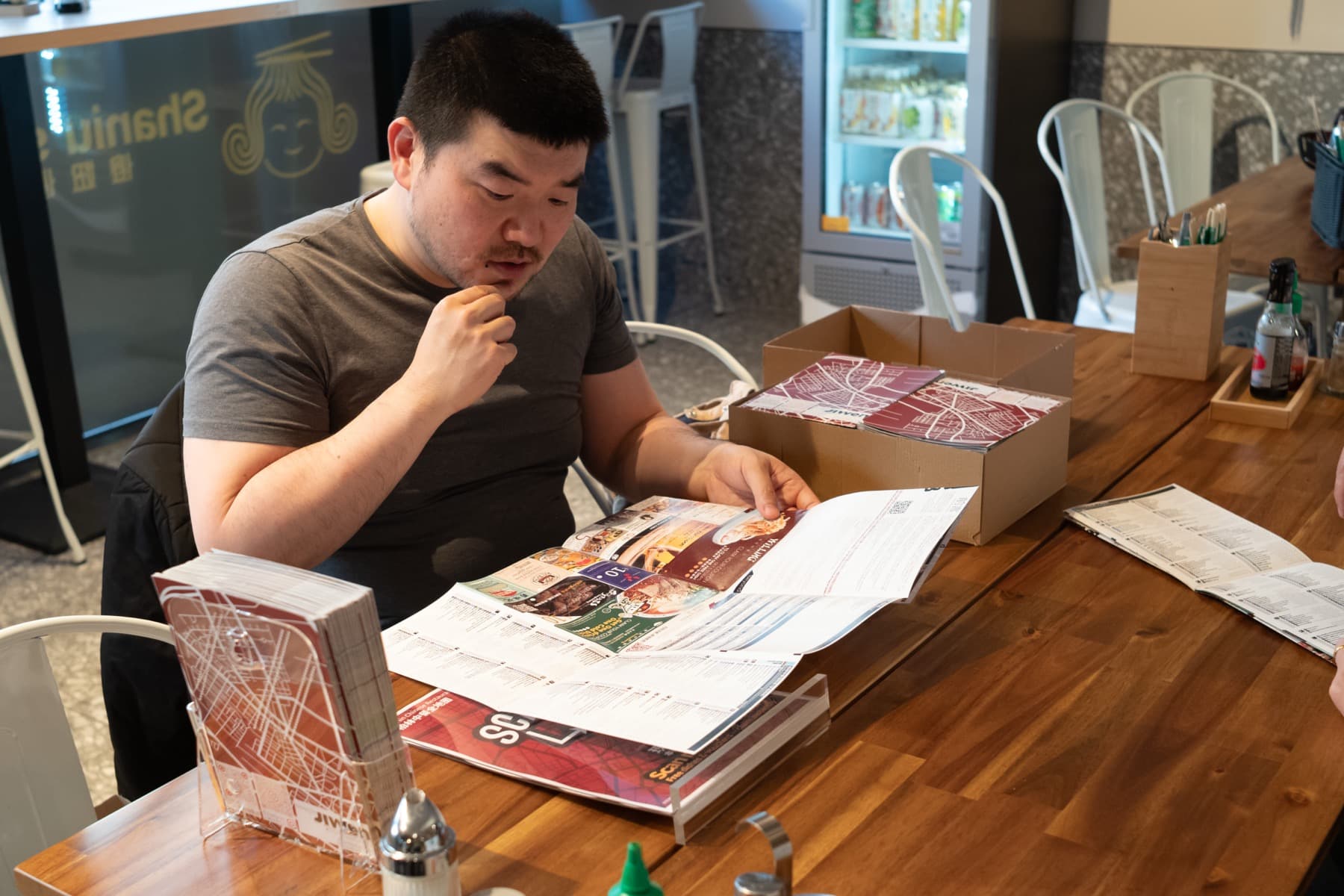
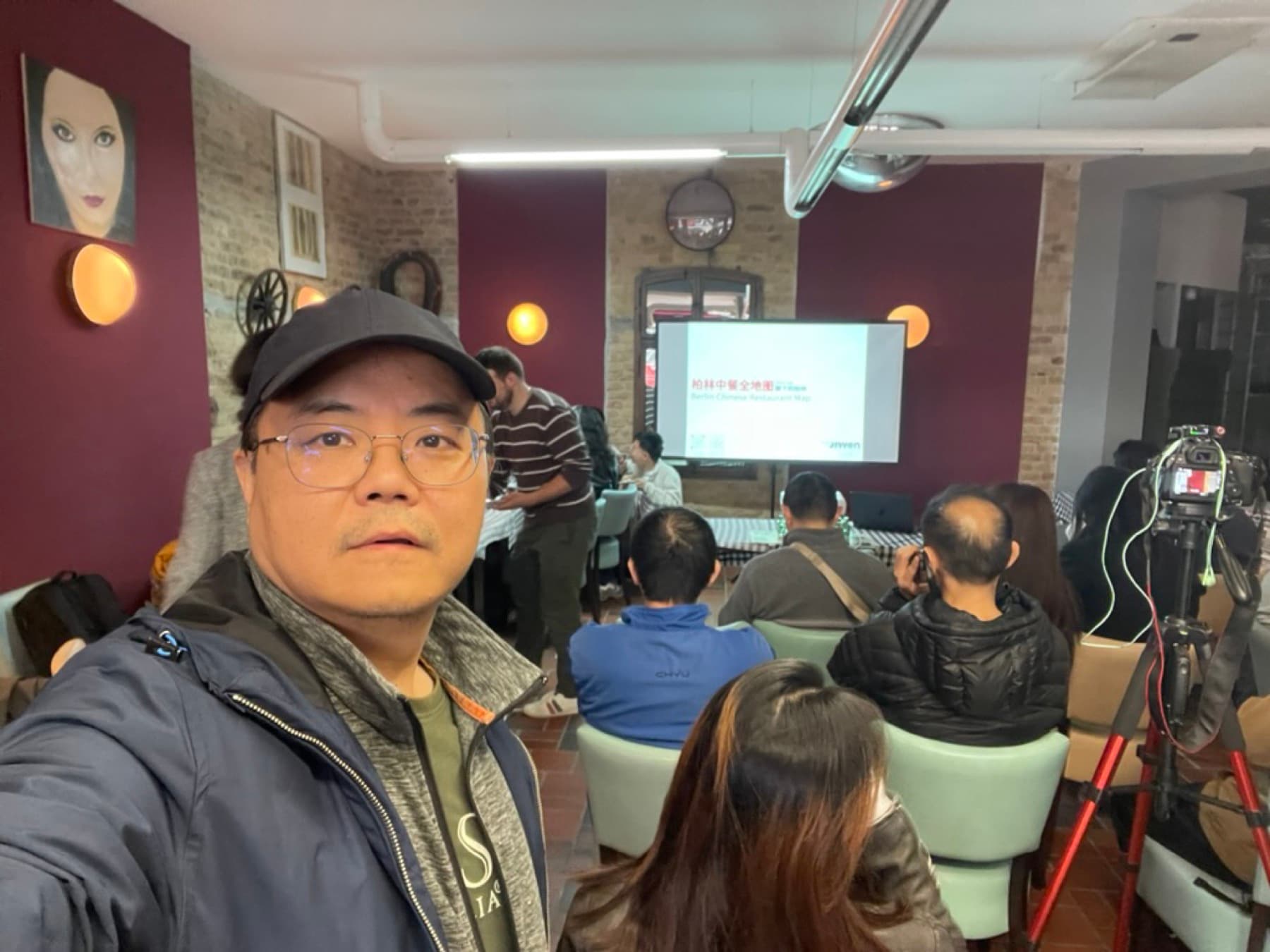
Before the map, there was walking
Rui Fang did not arrive in Berlin with a plan to build a restaurant map.
He started by walking.
He moved to Berlin in 2021 after more than two decades in Germany, most of them spent studying and working in the south. Berlin was not a foreign country to him, but it was still a city that had to be read slowly.
His routes were not the usual checklist of Brandenburg Gate, Museum Island and the East Side Gallery. Fang was drawn to the texture of neighbourhoods: the light inside a small chapel, the people buried in an old cemetery, the reason a gallery opened on a particular street, the feeling of a place that tourists rarely enter but Berliners recognize immediately.
The main purpose of Slowtour is to build a bridge for people, so they can understand Berlin, become familiar with it, and even feel more at ease living here.
That practice became Berlin Slowtour.
Slowtour is not a sightseeing list
Berlin Slowtour is not a one-day city tour. Its pace is deliberately slow. Fang brings people into galleries and lets them speak with the people who run them; he walks through cemeteries while explaining Hegel and Brecht; he enters bookshops in Neukölln and asks why someone would collect stickers from Berlin's walls.
After nearly 50 walks and close to 1,000 participants, the project had become a way for Chinese-speaking residents and visitors to form a more personal relationship with the city. Some participants were new arrivals. Others had lived in Berlin for years and realized they still knew only a thin layer of it.
The map came from the same impulse: make the city legible without flattening it.
From Leopoldplatz to a citywide food theme
Before the Chinese food map, Fang and designer Jiwen made a small neighbourhood map of Leopoldplatz. It included places Fang returned to himself: shops, streets, corners and everyday spaces that helped explain the area through one person's eye.
Only a few hundred copies were printed. Still, people began asking what would come next. Could they make a map for Charlottenburg? For Schöneberg?
The question eventually shifted. What if the next map was not about one neighbourhood, but about one theme?
Chinese food became the answer.
Could we present Chinese culture through a map, not only to Chinese people, but to everyone in Berlin? Chinese food was a good way in.
Chinese food had outgrown one street
For many Berliners, Chinese food still first means Kantstraße. That memory is not wrong, but it is no longer enough.
While walking the city, Fang saw a different pattern forming. Malatang shops appeared. Hand-pulled noodle restaurants multiplied. Hotpot, small-plate meals, Chinese breakfast, northeastern cooking, Sichuan and Cantonese food all became easier to name and place.
Chinese food was no longer concentrated on one street. Around Boxhagener Platz in Friedrichshain, near the meeting point of Wilmersdorf Straße and Kantstraße, around Uhlandstraße and in less expected neighbourhoods, new clusters were forming.
How do people find Chinese restaurants now? They look on Xiaohongshu, they look on Instagram, they look on Google Maps. The information is fragmented. I wondered whether there was another way to bring it together.
A restaurant found by accident
One evening in Bergmannkiez, Fang had planned to eat at a Greek restaurant. It was full. Nearby, he noticed a Chinese restaurant he had never recorded before. The menu was posted on the window, with Chinese dish names visible from the street.
He went in. Apart from him, there were almost no Asian faces in the room. When the server heard him speaking Chinese, there was a small moment of surprise and recognition.
It was a minor discovery, but it revealed the larger problem. Berlin's Chinese restaurants were too scattered, and changing too quickly, to be understood only through memory, social media saves and generic review apps.
Fang began organizing the information first on Xiaohongshu, then in a simple directory by neighbourhood. After several updates, he and Jiwen decided the directory needed to become a map.
A map you can unfold
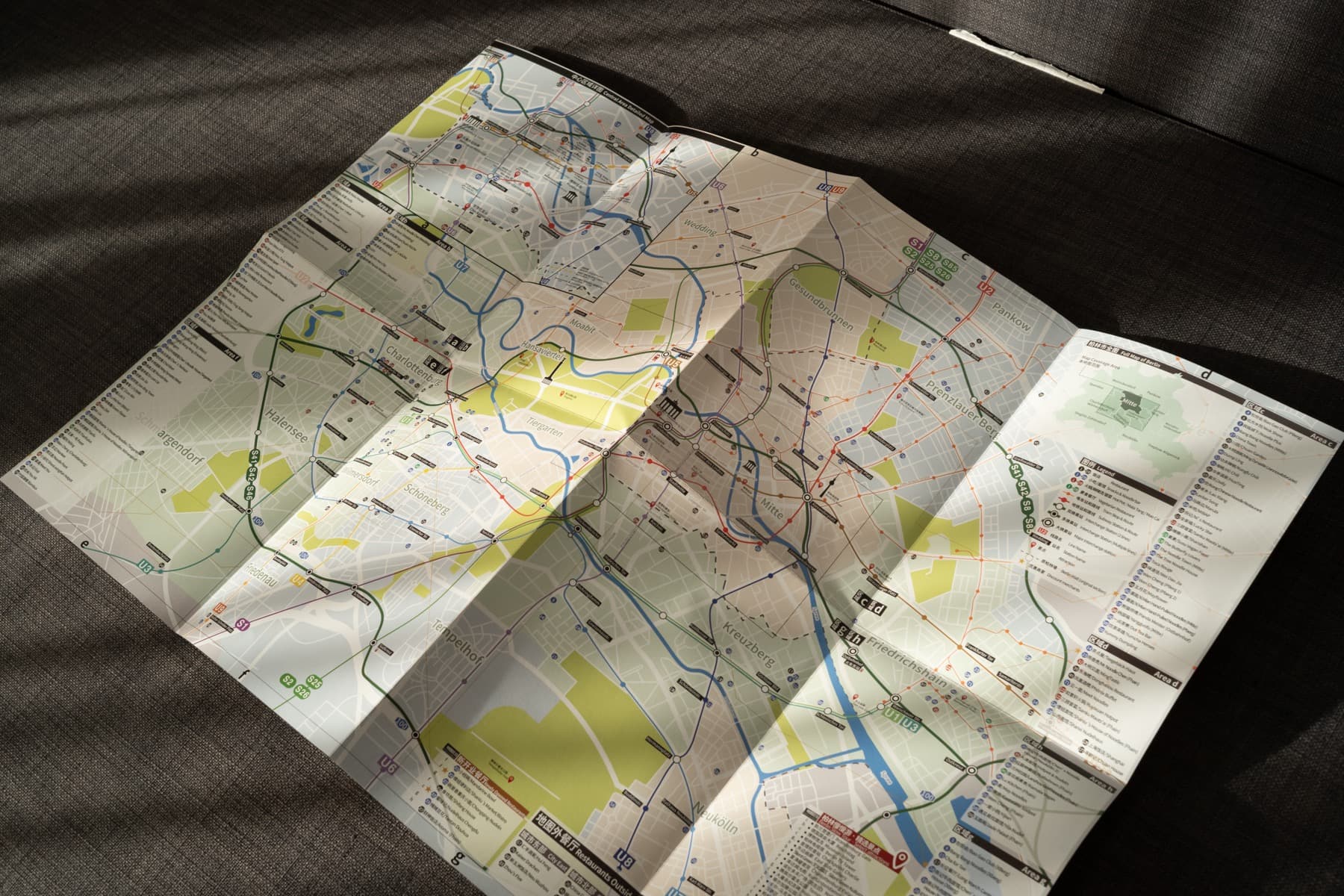
The printed Berlin Chinese Food Map records 207 restaurants as of January 2026.
It places those restaurants back into the physical city: waterways, green areas, administrative districts, streets, transit lines and neighbourhoods. The map is divided into eight zones, A to H. Every restaurant has a number. The reverse side adds an alphabetical index, a curated list of 20 picks and a cuisine-based search system.
It also thinks about visitors who have just arrived in Berlin. The city centre is enlarged, with walking routes from Hauptbahnhof to Brandenburg Gate and from Checkpoint Charlie to the TV Tower. A centimetre on the map corresponds to roughly 200 metres on foot, so distance can be measured with two fingers.
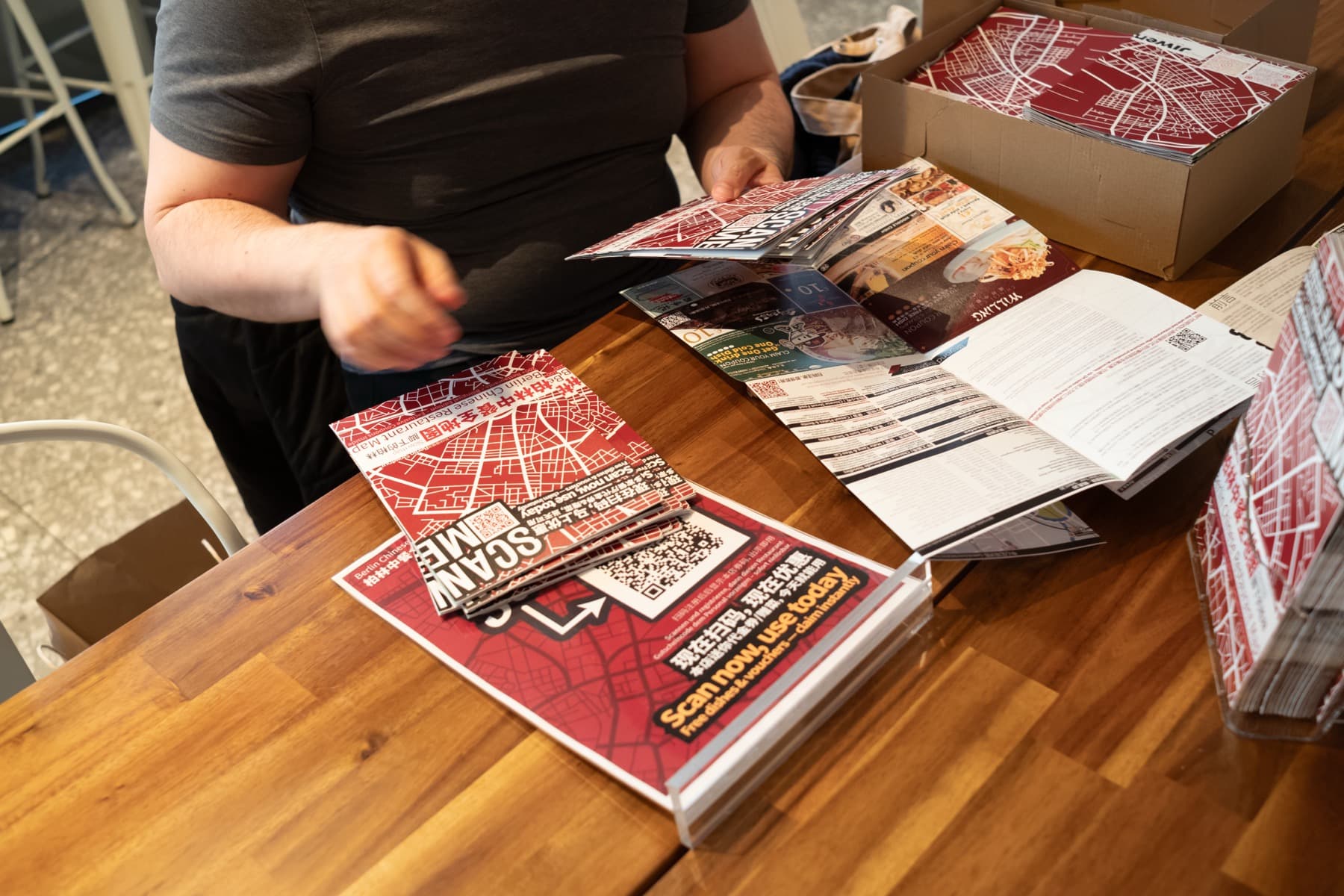
That physicality matters. The map can be opened on a table, pointed at by a friend, left at a restaurant counter or picked up at an event. It does not only answer the immediate question of where to eat. It shows, at a glance, how much Berlin's Chinese food landscape has changed.
We wanted to bring it to every corner of Berlin, not only to Chinese people, but to anyone interested in Chinese food.
The app is the map in motion
A printed map has limits. Restaurants open, move, change their hours or revise their coupons. When someone is standing on a street corner, they also need to know what is open now, how to get there, and whether they can search in Chinese, English or German.
That is where Berlin Chinese Food comes in. The app does not replace the printed map; it extends it. It adds photo-rich restaurant markers, cuisine and format tags, live opening status, trilingual search and directions.
The paper map gives people an entry point into Berlin's Chinese food landscape. The app keeps that landscape usable once they are outside, hungry and deciding where to go next.
Putting food back into the city
Fang's walks brought people into Berlin. The Chinese food map brings Chinese food back into the city.
Pinwo's role is to continue that work: gather the fragments scattered across posts, ratings, personal recommendations and walking notes, then turn them into a public entry point that more people can use.
For new arrivals, it reduces the first layer of uncertainty. For people who already live here, it offers a reason to look again at familiar streets.
A map may begin as dots and lines. But when those dots come from someone walking, eating, asking and organizing, it becomes something else: a way of telling the city again.
Keep exploring Chinese food in Berlin
Search Pinwo for Chinese restaurants, Sichuan food, noodle shops and malatang in Berlin.
Turn the story into your next meal
Use the restaurant map to find the dish, nearby Chinese restaurants and current offers.
Further questions
What is the Berlin Chinese Food Map?
The Berlin Chinese Food Map is Pinwo's printed and digital guide to Chinese restaurants across Berlin. The printed version records 207 restaurants as of January 2026; the app extends the map with search, filters, live opening status and directions.
Who is Rui Fang?
Rui Fang is the founder of Berlin Slowtour, known on Xiaohongshu as @Berlin Slowtour in Chinese. His walking tours connect people with Berlin neighbourhoods, galleries, cemeteries and local spaces; the food map grew from that same practice.
Where can I download Berlin Chinese Food?
You can download Berlin Chinese Food from the App Store. It is built for the moment before you leave, or while you are already out: search by dish, cuisine or neighbourhood, check whether a place is open, then continue straight to directions.
Where can I pick up the printed map?
You can pick up a free printed map at participating partner restaurants. Pickup spots are updated on the locations page, where the current restaurant list is grouped by area.
View pickup locations